
Federalism does not have to wait for constitutional reform – communities are already applying it – AfriForum Institute for Federalism
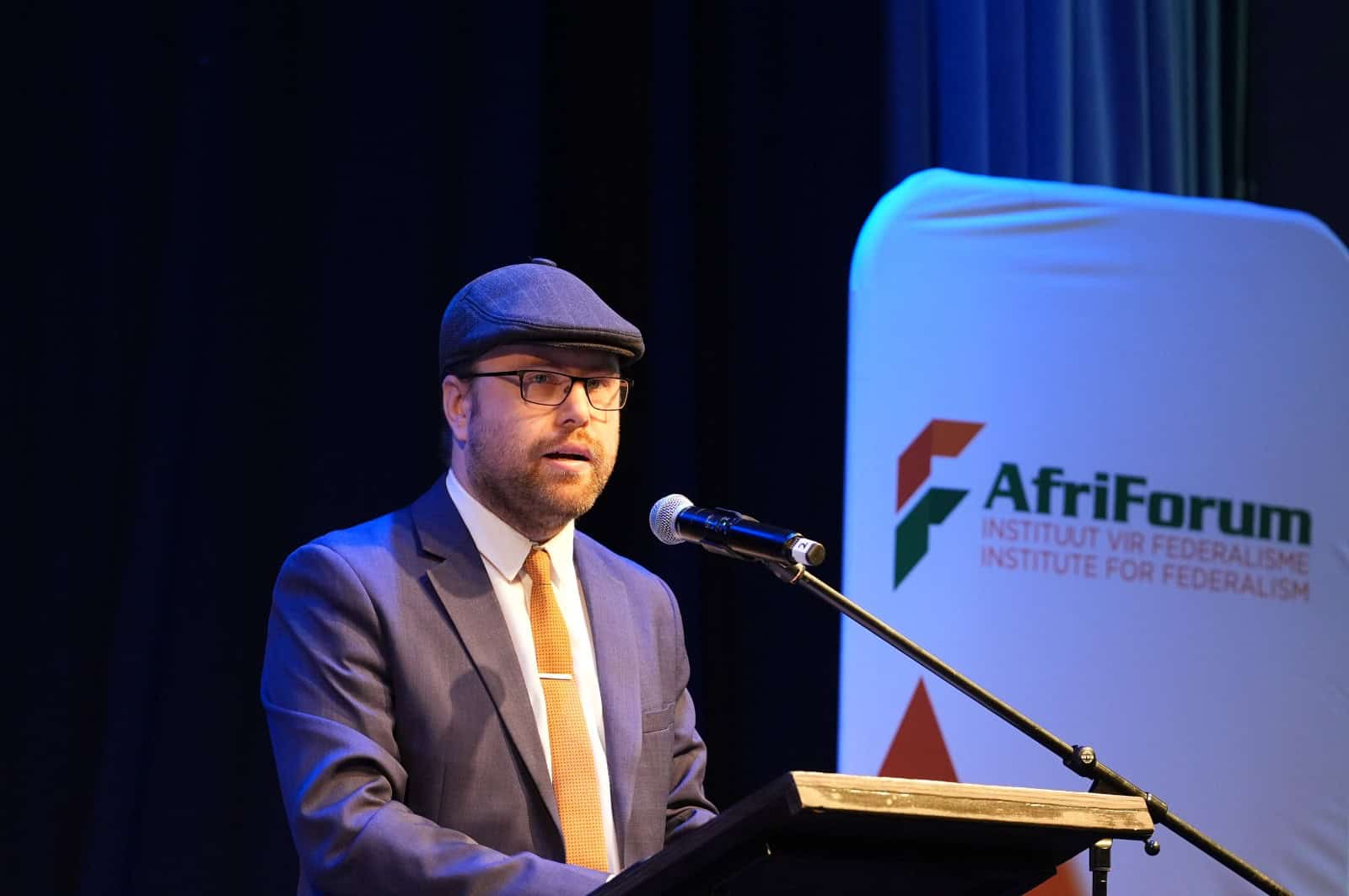
Communities do not need to wait for political or constitutional reform to put federalism into practice. The establishment of community institutions – such as AfriForum and other entities within the Solidarity Movement – through which communities themselves take responsibility for their own safety, education, and even basic service delivery, demonstrates that federalism is already developing from the grassroots level. This is the core message conveyed by Dr Martin van Staden, head of the newly established AfriForum Institute for Federalism (AIF), in his public lecture titled “Federalism and Federation in South Africa Today,” which was presented today (11 November) at the AfriForum Theatre.
This new institute serves as the civil rights organisation’s general research and policy development center, and as an instrument for promoting thought and research on federalism, self-determination, decentralisation, and community autonomy and participation. The AIF strives to establish an intellectual foundation for a future in which communities can exercise greater authority and responsibility over their own affairs.
Today’s public lecture is the first of its kind for the AIF.
According to Van Staden, South Africa is already constitutionally a federation, despite the perception that the country is a unitary state. He maintains, however, that the country’s constitutional framework has failed to allow federalism to develop in any meaningful way, as political and financial authority remains largely centralised.
“The current Constitution of South Africa is a federal constitution in structure and design, as provincial and municipal powers are constitutionally entrenched rather than being subject to the discretion of the central government,” explains Van Staden.
However, he warns that constitutional provisions alone are insufficient to ensure the decentralisation of powers.
“We have a formal federal Constitution that lacks the substance of federalism, and we have a vibrant and prosperous federalist reality developing at the grassroots level, without much of a federal form,” adds Van Staden.
In his lecture, Van Staden examined, among other things, South Africa’s federalist tradition since the 1850s, highlighting how federalism was considered time and again – notably during the negotiations preceding the establishment of the Union of South Africa in 1910 – as an alternative to centralised political authority. Although a unitary system was ultimately adopted at the time, federalist ideas continued to influence political movements throughout the 20th century.
He argues that history shows that federalism has never belonged exclusively to a single cultural group or political community; rather, various communities recognised its potential to protect local autonomy and limit the concentration of political power.
Van Staden believes that these initiatives are more than just a temporary response to the failure of public services, and that they instead demonstrate how communities can build institutions and take responsibility for their own interests in a meaningful way.
“It is important to distinguish federalism from the mere decentralisation of government functions, since true federalism requires communities to take responsibility for their successes and failures,” emphasises Van Staden.
Van Staden believes that, while constitutional reform is important, the practical development of self-sustaining communities is the immediate priority. “As these institutions become more established, opportunities may arise to entrench their authority through constitutional arrangements,” he concludes.